Bitfinex
On this page
Bitfinex: Quick Facts
- Founded
- 2012
- Headquarters
- British Virgin Islands (iFinex Inc.)
- Owner / Operator
- iFinex Inc., which also owns Tether
- Type
- Centralized exchange (CEX), professional and margin focus
- Custody
- Custodial
- Native token
- LEO (UNUS SED LEO), issued 2019; 80 percent of recovered 2016 hack Bitcoin is committed to buying and burning it
- Availability
- Global; US retail customers restricted
Bitfinex is a centralized cryptocurrency exchange launched in 2012, which makes it one of the two oldest venues still operating at scale. It is built for professional traders rather than newcomers, with deep order books, a margin system and a peer-to-peer funding market that has no real equivalent elsewhere. It is also the exchange that lost nearly 120,000 Bitcoin in 2016, and the consequences of that theft still determine how its token trades a decade later.
Built for Traders, Not Beginners
Bitfinex's product set assumes you already know what you are doing. There is spot trading in Bitcoin, Ethereum and a curated set of altcoins, and on top of that an unusually complete professional toolkit: margin trading, derivatives, algorithmic order types, a full API stack and customisable multi-panel layouts.
The genuinely distinctive piece is the funding market. Rather than the exchange lending you money for margin, Bitfinex runs an order book for credit: lenders offer capital at rates and durations they choose, borrowers take it, and the exchange matches them. That means margin borrowing costs are set by supply and demand in a visible book rather than by a platform-set rate, and it gives lenders a yield product whose risk is legible in a way most earn programmes are not. It is the feature professional users cite most, and almost nobody has copied it.
The corollary is that Bitfinex is a poor first exchange. The interface density, the margin mechanics and the absence of hand-holding all assume competence, and crypto beginners will find a simpler venue serves them better.
August 2, 2016: 119,756 Bitcoin
On August 2, 2016, attackers drained 119,756 BTC from Bitfinex, worth roughly USD 72 million at the time. It remains one of the largest exchange thefts ever recorded.
What Bitfinex did next was unusual and is the reason the company still exists. Rather than declare insolvency, it socialised the loss across every account, applying a haircut of roughly 36 percent to all customer balances regardless of whether the individual had been affected. In place of the deducted funds it issued BFX tokens, redeemable claims against future recovery. Within about eight months it had redeemed all of them, either for cash or for equity in iFinex, its parent company.
Judged one way, that is an impressive recovery that made customers whole where most exchanges of that era simply collapsed. Judged another, it means every Bitfinex user in 2016 involuntarily became a creditor of the exchange and absorbed a share of a loss they had no part in. Both readings are accurate, and the episode is the clearest illustration available of what custodial risk actually means: your balance at an exchange is a claim on that company, and a claim can be written down.
LEO, and the Strangest Token in Crypto
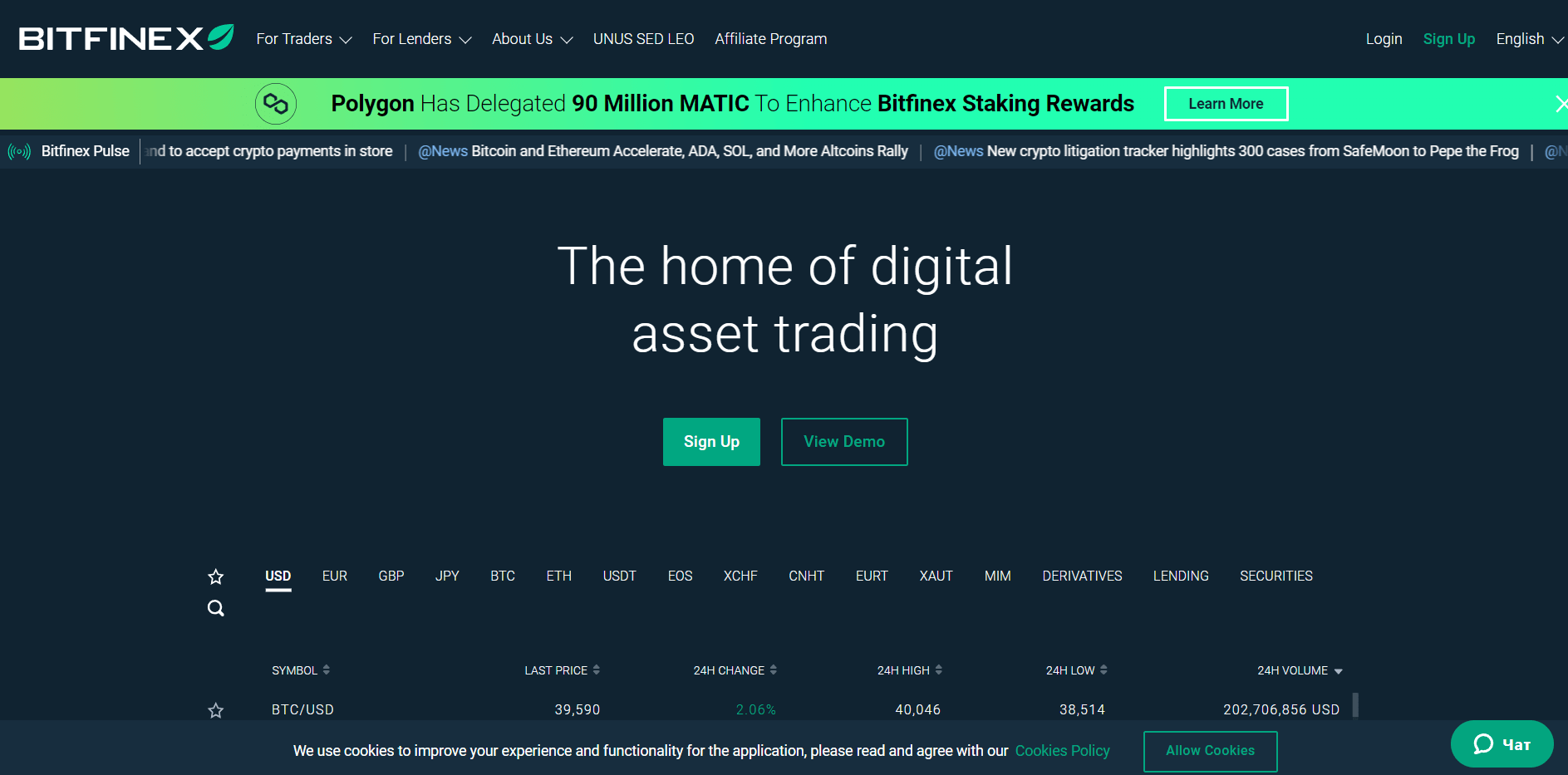
UNUS SED LEO was issued in 2019 to shore up iFinex's finances after a series of setbacks including the hack. It provides fee discounts and platform benefits, which is conventional. What is not conventional is the redemption mechanism.
Bitfinex has committed to using 80 percent of any Bitcoin recovered from the 2016 hack to buy LEO on the open market and burn it. That ties the token's value directly to the recovery of specific stolen coins, which makes LEO less an exchange token than a tradeable claim on a law enforcement outcome.
The mechanism has already moved. US authorities seized approximately 94,636 BTC linked to the hack in 2022, and LEO rose around 59 percent on the news. In February 2026 analysts noted a renewed premium on LEO as speculation grew about movement on those coins, which are reported to account for roughly 30 percent of the US Strategic Bitcoin Reserve.
That is an extraordinary situation to hold a position in. The token's upside depends on whether and when the United States government releases Bitcoin it seized from criminals who stole it from Bitfinex, and that decision is a matter of US policy rather than of exchange performance. Anyone trading LEO should understand they are trading a legal and political process, and crypto volatility here has causes unrelated to the market.
The Tether Relationship
Bitfinex is operated by iFinex Inc., which also owns Tether, the issuer of USDt. The two companies share ownership, management and history, and the relationship is the most persistent source of scrutiny around both.
In 2021 the New York Attorney General concluded that Tether's representations about its reserves had been misleading for certain periods, and that funds had moved between the two entities in ways that had not been disclosed. Tether and Bitfinex paid USD 18.5 million and ceased serving New York customers. The CFTC brought a related action the same year. Those are findings, not allegations.
The structural concern that follows is simple: the exchange with among the deepest order books in crypto shares an owner with the issuer of the dollar token most of the market settles in. Whatever the conduct today, that concentration means the two entities' fortunes are linked, and a problem at one would not stay contained.
Both have since moved their centre of gravity. Tether relocated its headquarters from the British Virgin Islands to El Salvador in January 2025, and on May 12, 2026 Bitfinex secured a Digital Asset Service Provider licence there, completing a set alongside Bitfinex Securities and Bitfinex Derivatives that covers spot trading, derivatives and tokenised securities in a single jurisdiction.

Security and Transparency Since
Bitfinex publishes proof-of-reserves data and keeps the majority of client assets in cold storage, with segregated multi-signature wallet infrastructure introduced after 2016. It has not suffered a comparable breach since, which after a decade is meaningful evidence rather than luck.
It remains custodial, unlicensed in most major markets, and restricted to non-US retail customers. Proof of reserves shows assets at a moment and says nothing about liabilities, so it is a weaker assurance than an audit. The practical conclusion is the one the 2016 haircut taught directly: trade here, hold elsewhere, and treat how to store crypto in self-custody as the default for anything you are not using as collateral.
Practical Cautions
- The 2016 haircut is the case study. Your exchange balance is an unsecured claim on the operator. Bitfinex honoured it; that was a choice, not an obligation.
- LEO is not an ordinary exchange token. Its central value driver is US government disposal of seized Bitcoin. Do not model it on BNB or similar.
- Margin here is real margin. The funding market is excellent and the liquidation engine is indifferent to your reasoning. Size positions for the adverse case.
- iFinex concentration is a genuine exposure. Shared ownership with Tether means a Tether problem is a Bitfinex problem, and USDt collateral on this venue compounds rather than diversifies that.
- El Salvador licensing is not EU or US licensing. It is a real regulatory framework and a permissive one. Know which entity you are contracting with.
- Account hygiene matters more without support. Hardware-key two-factor authentication and withdrawal allowlisting, and treat unsolicited contact as hostile, because crypto scams aimed at you get no platform remedy.
Where Bitfinex Stands
For professional traders, Bitfinex remains genuinely strong: deep liquidity, a peer-to-peer funding market nobody else offers, serious API infrastructure and fourteen years of continuous operation through cycles that removed almost all of its contemporaries. Survival at this length in this industry is itself information, and its post-2016 security record supports the case.
The reservations are structural rather than about execution. It is custodial and largely unlicensed in the markets with the strongest consumer protections, it shares an owner with the most systemically important stablecoin issuer, and both companies carry 2021 regulatory findings about how they described themselves. A trader who understands understanding crypto exchanges as counterparty selection can weigh that. Someone choosing between trading and holding should note that nothing here argues for holding.
Bitfinex is best understood as the veteran that paid for its worst day out of its customers' balances and then earned them back. That is a better record than most, and it is still a reason to keep only what you are trading with on the platform.
Visit Exchange
Learn more about this cryptocurrency exchange platform
This is not financial advice. Cryptocurrency exchanges involve significant risks, including potential loss of all funds. Always verify the platform is legal in your jurisdiction and never invest more than you can afford to lose.
Bitfinex: Frequently Asked Questions
What is Bitfinex?
Bitfinex is one of the longest-running cryptocurrency exchanges, launched in 2012. It offers spot, margin, and derivatives trading and is known for deep liquidity and advanced trading features aimed at experienced traders.
Is Bitfinex safe?
Bitfinex suffered a major hack in 2016 in which roughly 120,000 BTC were stolen. It issued recovery tokens and later made affected users whole, and a large portion of the funds was eventually seized by US authorities. Security has since been strengthened, but it remains a custodial exchange.
Is Bitfinex connected to Tether?
Bitfinex and Tether (USDT) share common ownership through their parent company iFinex. The relationship has attracted regulatory scrutiny, including a 2021 settlement with the New York Attorney General.
Does Bitfinex serve US customers?
Bitfinex restricts US retail customers, though some services may be available to eligible US institutional clients. Check the current terms for your jurisdiction.
Free Crypto Tools
*Disclaimer: The information provided here is for informational purposes only and does not constitute financial advice. Cryptocurrency trading involves risks, so please DYOR. For beginners, check out our Beginners Guides to learn more.