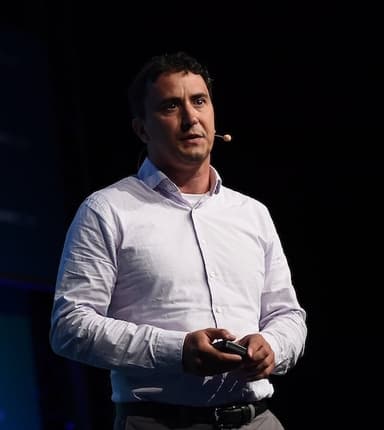
Emin Gün Sirer
On this page
Emin Gün Sirer: Quick Facts
- Birthplace
- Istanbul, Turkey
- Nationality
- Turkish-American
- Education
- Princeton University; University of Washington (PhD)
- Known for
- Avalanche consensus, Ava Labs, selfish mining research, Bitcoin-NG
- Current role
- Founder and CEO of Ava Labs
- Status
- Still leading Ava Labs as of September 2026
Emin Gun Sirer is a Turkish-American computer scientist who spent close to two decades as a distributed systems researcher at Cornell before founding Ava Labs and launching Avalanche. He is unusual among crypto founders in that his reputation was established by peer-reviewed work that embarrassed the industry, several years before he built anything in it.
The Academic Who Broke Things First
Sirer studied at Princeton and took his doctorate at the University of Washington, then joined Cornell as a professor working on operating systems, networking and distributed consensus. He had built a digital currency with a proof-of-work component, Karma, in 2003, five years before the Bitcoin whitepaper.
What made his name in crypto was adversarial analysis rather than construction.
In 2013, with Ittay Eyal, he published the selfish mining paper, which demonstrated that Bitcoin mining was not incentive-compatible in the way the whitepaper assumed. A miner controlling meaningfully less than half the hashrate could increase their revenue share by strategically withholding blocks rather than publishing them immediately. The finding contradicted a widely held belief that honest mining was always the optimal strategy below 51 percent, and it was not warmly received. It has held up.
His group also produced Bitcoin-NG, a proposal to decouple leader election from transaction throughput, and an analysis of The DAO's vulnerabilities published before the 2016 exploit that drained it. Being right in public, in advance, on a subject the ecosystem preferred not to examine, is the throughline of his pre-Avalanche career.
Avalanche Consensus: A Third Approach
The contribution that matters technically is the consensus family Avalanche is named after, and it is genuinely distinct from what came before.
Classical Byzantine fault tolerant protocols achieve fast finality but require every validator to communicate with every other validator, so they do not scale past a modest committee. Nakamoto consensus, used by proof of work chains, scales to anyone who wants to participate but offers only probabilistic finality, which is why exchanges wait for confirmations.
Avalanche uses repeated randomised sampling. Rather than polling the whole network, each validator repeatedly asks a small random subset what they think, and shifts its own position toward the majority it observes. Under reasonable assumptions the network converges to agreement quickly, with high probability, and the communication cost per validator stays roughly constant as the validator set grows. It is a metastability argument rather than a quorum argument, and it was a legitimately new direction in a field where new directions are rare.
The practical consequence is a finality figure of roughly a second, against Bitcoin's hour of confirmations for large transfers. The cost is that the guarantee is statistical: the network converges with overwhelming probability rather than with the deterministic certainty a classical quorum provides. For most payments that distinction is academic. For a settlement system moving institutional size it is the thing a risk committee will want to understand, and it is why the protocol's assumptions about network conditions matter as much as its throughput numbers.
Avalanche launched in 2020 with a three-chain architecture, separating token transfers, smart contract execution and subnet coordination, with proof of stake securing the network. The execution chain is compatible with Ethereum tooling, which was a deliberate decision to let developers port existing Ethereum contracts rather than learn a new environment, and it is a large part of why the ecosystem filled as quickly as it did.
Subnets, and the Bet That Now Defines It
Avalanche's strategic wager was never to be the fastest general-purpose chain. It was that serious institutions would want their own chains, with their own validator sets, rules and compliance requirements, while still settling against shared infrastructure.
That is what subnets, since renamed layer 1s within the Avalanche ecosystem, are for. It is a different answer from Ethereum's, where layer-2 networks inherit security from the base chain, and different again from Solana's single high-throughput chain that Anatoly Yakovenko built.
The Avalanche9000 upgrade made launching these networks materially cheaper, which is the change that turned the thesis from a pitch into an economic proposition. Sirer's argument in 2026 is that institutions now treat Avalanche as infrastructure for moving value between applications, and the supporting evidence is the type of participant showing up: executives from BlackRock, Apollo, Franklin Templeton and the NYSE spoke at Avalanche Summit 2026, and professional sports teams and local governments have deployed on it.
Whether that converts into durable activity is the open question. Custom institutional chains are a plausible market and a slow one, and a network's value in this model depends on how many of those chains succeed rather than on how many launch. Real-world asset tokenization is the use case most often cited, and it has been cited for several years now.
The Criticisms
Three are worth stating fairly.
Avalanche's fast finality comes with assumptions. The protocol's guarantees are probabilistic and rest on network conditions and on validators behaving as modelled. Critics argue the practical decentralisation of the validator set, and the cost of running one, concentrate influence more than the design implies. The network has also experienced outages, which is a problem the architecture was supposed to make unlikely.
The token distribution drew the standard objection: a large allocation to the team, foundation and early investors relative to public sale participants. Avalanche is not unusual in this among chains of its generation, which is a mitigation of the comparison rather than of the fact, and anyone weighing AVAX should look at the unlock schedule rather than the circulating supply alone.
And Sirer's own combativeness cuts both ways. The willingness to publish uncomfortable findings that made his academic reputation reads differently once he has a token to defend, and his public disputes with rival ecosystems have sometimes been closer to promotion than to analysis. That is a fair criticism of the founder without being a criticism of the consensus work, and both things can be true.
Why Sirer Is Worth Reading
Sirer represents a lineage in crypto that is easy to overlook: the academic distributed systems community, which was working on consensus and incentive compatibility before Satoshi Nakamoto and has kept working on it since.
His most valuable output was not a chain. It was the selfish mining result and the DAO analysis, both of which told the industry something it did not want to hear and both of which proved correct. That habit of testing claims adversarially rather than accepting them is the most transferable thing about him, and it is in short supply in an industry that mostly rewards conviction. The selfish mining paper is still worth reading for anyone who assumes a whitepaper's incentive claims have been verified simply because the network has not yet failed.
The honest summary is that Avalanche is a technically serious network with a coherent institutional thesis that has not yet been decisively validated, run by someone whose analytical judgement has been demonstrated repeatedly and whose promotional statements should be read as promotional. Assessing it means separating the consensus mechanism, which is a real contribution to computer science, from the market positioning, which is a business claim like any other and deserves the same scepticism you would apply to any exchange or token listed on Coinbase or Binance.
Emin Gün Sirer: Frequently Asked Questions
Who is Emin Gün Sirer?
Emin Gün Sirer is a computer scientist and Cornell professor known for foundational research on cryptocurrency incentives and scalability. He co-founded Ava Labs and led the development of Avalanche, a high-performance Proof-of-Stake blockchain. His work spans selfish mining theory, Bitcoin-NG, and production-grade consensus engineering.
What is Avalanche and how is it different from other blockchains?
Avalanche is a Layer 1 blockchain that uses a family of probabilistic, sampling-based consensus protocols designed for high throughput and fast finality. It features EVM compatibility, a tri-chain architecture, and subnets for application-specific networks. Unlike rollup-centric approaches, Avalanche emphasizes scaling at Layer 1 with customizable subnet deployments.
What are Emin Gün Sirer's most cited academic contributions?
His most cited works include the 2013 selfish mining paper, which highlighted incentive vulnerabilities in Bitcoin, and the 2015 Bitcoin-NG proposal for improved throughput and latency. He also helped formalize research around smart contracts and permissionless consensus, shaping how builders evaluate security and decentralization trade-offs.
Was Emin Gün Sirer involved in The DAO vulnerability discussions in 2016?
Yes. During The DAO's rise in 2016, Sirer and collaborators publicly discussed contract-level vulnerabilities and risk. The ensuing events reinforced the importance of rigorous engineering practices for smart contracts and influenced how the industry approaches audits and upgrades on programmable platforms.
Has Emin Gün Sirer faced controversies?
Like many high-profile crypto figures, Sirer has been involved in public controversies, including disputes surrounding industry legal tactics and token model debates. He and Ava Labs have publicly denied allegations of improper conduct. These episodes highlight how competitive dynamics and legal battles can shape perception in fast-evolving markets.