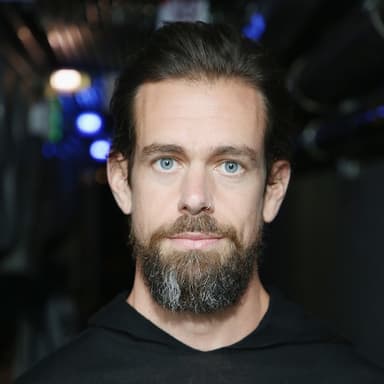
Jack Dorsey
On this page
Jack Dorsey: Quick Facts
- Born
- 1976
- Birthplace
- St. Louis, Missouri, USA
- Nationality
- American
- Known for
- Co-founding Twitter and rebuilding Block around Bitcoin
- Current role
- Co-founder, principal executive officer and chairman of Block
Jack Dorsey: The Bitcoin-First Builder Behind Block and Cash App
Jack Dorsey did not enter crypto to chase every possible token or trend. He took a singular path. As co-founder of Twitter and founder of Block, Dorsey became one of the most visible advocates of Bitcoin as the native money of the internet. From putting Bitcoin buy-sell features into Cash App, to funding open source development through Spiral, to shipping a hardware wallet and a mining business inside Block, his imprint runs through the industry's financial plumbing more than its memes. Where many see a landscape of coins, Dorsey sees one protocol that matters.
"Bitcoin changes absolutely everything. I don't think there is anything more important in my lifetime to work on." - Jack Dorsey, 2021
He helped normalize the idea that a public company could hold BTC on its balance sheet, that a mainstream consumer app could integrate Lightning, and that self-custody should reach everyday users. Dorsey is not a maximalist by marketing. He is a Bitcoin-first builder by practice, and he has repeatedly cancelled his own projects when they drifted from that focus.
Early Life and Background
Born in 1976 and raised in St. Louis, Missouri, Dorsey grew up fascinated by how information moves in real time. As a teenager, he taught himself programming while studying dispatch and logistics systems, an obsession that foreshadowed his interest in networks without single points of failure. After brief stints in New York and the Bay Area tech scenes, he co-founded Twitter in 2006, turning the abstraction of real-time communication into a cultural force.
In 2009, he launched Square to lower barriers in payments for small businesses. The company would later become Block in December 2021, a restructuring that grouped Cash App, Square, Spiral, TBD, and TIDAL under one roof. Long before he publicly championed Bitcoin, Dorsey had a habit of reducing complex systems to simple, accessible tools. That habit would shape his crypto journey.
Entry into Crypto
Dorsey began mentioning Bitcoin publicly in the mid-2010s, but 2018 marked a point of no return. That year he personally invested in Lightning Labs and said he believed the internet would eventually have a single currency.
"The world ultimately will have a single currency. The internet will have a single currency. I personally believe that it will be bitcoin." - Jack Dorsey, 2018
His rationale was not speculative price talk. Dorsey framed Bitcoin as a protocol for value that mirrors how the internet routes information. In 2019, he created Square Crypto, later rebranded as Spiral, to fund open source Bitcoin development independently of commercial pressures. In October 2020, Square purchased 4,709 BTC for its treasury, and in February 2021, the company added roughly 170 million dollars more. The message was clear: if you believe in an open monetary standard for the internet, you participate directly.
By September 2021, Twitter under Dorsey introduced Bitcoin tipping for creators using the Lightning Network, one of the earliest mainstream experiments in streaming internet-native value at negligible cost. He resigned as Twitter chief executive that November, saying the company was ready to move on from its founders, and turned his full attention to payments and Bitcoin.
For readers new to the foundation he chose, see the primer on What is Bitcoin? and why its monetary design and origin under Satoshi Nakamoto continue to attract builders.
Major Contributions and Projects
Dorsey's most enduring crypto work lives inside Block. Rather than launch a token, he pushed for neutral rails that everyday users and developers could adopt.
Cash App and Bitcoin access
Cash App began offering users the ability to buy and sell BTC in 2018, turning one of the most popular consumer finance apps in the United States into an on-ramp for Bitcoin. Over subsequent years, Cash App introduced features for sending and later receiving Lightning payments, treating micropayments as a native internet primitive. For many users, this was their first exposure to a Bitcoin wallet that felt as simple as sending a message.
Treasury and mainstream corporate signal
Block's BTC treasury moves in 2020 and 2021 signaled that public companies could treat BTC as a long-duration asset on par with cash alternatives. Dorsey's stance aligned him with other high-profile corporate adopters such as Michael Saylor, and helped normalize the idea inside boardrooms and CFOs' playbooks. For broader context on how enterprises entered the space, see Major Corporate Movements in the Crypto Space.
Spiral and open source Bitcoin development
Spiral, the open source initiative Dorsey launched in 2019, was designed to fund long-term public goods in the Bitcoin ecosystem. Its grants and projects supported developers working on the Lightning Network, the Lightning Development Kit, UI kits for Lightning-enabled apps, and maintenance of protocol-level infrastructure. Spiral's posture matches Dorsey's belief that the most valuable crypto work happens at the protocol layer rather than in speculative tokens. Builders curious about extending protocol utility across industries can explore How Smart Contracts Are Transforming Industries, even as Dorsey's center of gravity remains Bitcoin-first.
Proto and the open mining stack
Viewing mining as critical to the resilience of Proof-of-Work, Block set out to build an open mining system with custom silicon, aiming to broaden access and reduce supply chain bottlenecks. That effort became Proto, which now sells hardware rather than promises. The Proto Rig is modular, with swappable parts designed to keep a machine productive for around ten years instead of the usual three to five, and Proto Fleet is open source software for managing mining operations. The goal was never only efficiency. It was decentralization, making it easier for individuals and small operators to participate. For the economics and tradeoffs of securing a PoW network, see What Is the Bitcoin Halving?.
Bitkey and self-custody
In 2021 Dorsey floated the idea of a Bitcoin hardware wallet built in the open. Block's Bitkey, announced in 2022 and released to the public in 2023, offered a self-custody experience built around secure hardware, a mobile app, and recovery options that respected sovereignty without sacrificing usability. Dorsey's premise was that if you want decentralization to endure, you must make self-custody simple enough for non-experts. For general best practices, see How to Safely Store Your Cryptocurrency.
TBD, tbDEX, and the Web5 detour
Dorsey's TBD initiative proposed tbDEX, a decentralized exchange protocol for identity-verified value transfer without a centralized intermediary. In 2022, TBD laid out Web5, a suite built on decentralized identifiers and web nodes rather than a token-centric model. The goal was to put identity, data, and value in users' control at the edges of the network. It did not survive contact with Dorsey's own priorities. In November 2024, Block wound down TBD entirely, scaled back its TIDAL investment, and redirected the money into Bitcoin mining, contributing the Web5 identity primitives to the Decentralized Identity Foundation on the way out. For a grounding in the mainstream narrative he often critiqued, see What is Web3? and how it differs from building on Ethereum and other programmable chains.
As these efforts matured, Dorsey kept bringing the conversation back to fundamentals: hard money, energy-backed security, user-controlled keys, and interoperability across the open internet. When newcomers ask where to start, the practical answer runs through What Are Layer 2 Blockchains? and Lightning's role in scaling BTC payments.
Philosophy and Vision
Dorsey's philosophy can be summarized in three pillars. First, decentralization is not a buzzword. It is the only way to preserve freedom at internet scale. Second, incentives matter. Protocols that survive do so because they align human and machine incentives cleanly, not because they promise features. Third, user control over identity and keys is the final mile of digital sovereignty.
"If I were not at Square or Twitter, I would be working on Bitcoin." - Jack Dorsey, 2021
These beliefs made him a lightning rod. He has critiqued token-centric models of Web3 as potentially captured by venture interests, arguing that many so-called decentralized applications route value through centralized choke points. That critique eventually landed on a project he had funded himself: he left the board of Bluesky in May 2024, complaining that everything they had wanted around decentralization had turned into a company with venture capitalists and a board. For readers coming from a programmable chain mindset, compare his view with the evolution of Ethereum and the arguments of builders like Vitalik Buterin who emphasize expressiveness and composability.
Dorsey redirected that energy into Nostr, a simple relay-based social protocol that favours censorship resistance and client choice over centralized feeds. He donated 10 million dollars to OpenSats to fund free and open source Bitcoin and Nostr work, and Nostr has since become the substrate for his own side projects.
Finally, his energy stance is pragmatic. He has backed the argument that Bitcoin mining can strengthen renewable grids by acting as a flexible buyer of last resort. If mining draws critique, Dorsey argues the better conversation is how to align mining with clean energy and grid stability. For a deeper look at that debate, see Can Crypto Go Green? The Environmental Impact.
Controversies and Criticism
Dorsey's Bitcoin-only focus draws both admiration and pushback. Supporters credit him with maintaining principle in a hype-heavy industry. Critics describe it as maximalism that ignores innovation on other chains. His rejoinder is that Bitcoin's simplicity and neutrality are features, not bugs.
Twitter moderation policies during his leadership also colored perceptions. Some in crypto framed centralized moderation as incompatible with the decentralization he championed elsewhere. Dorsey has since acknowledged mistakes and pressed for protocol-based social media.
His decentralized tooling has also collided with governments. Bitchat, the Bluetooth mesh messenger he launched in July 2025, passes messages phone to phone without any internet connection, and in July 2026 India's cybercrime agency ordered GitHub to take down its repositories, arguing that a registration-free design defeats lawful interception. Dorsey treats that friction as evidence the design works. Regulators treat it as a warning.
The sharpest criticism is closer to home. In February 2026, Block cut more than 4,000 jobs, close to half its workforce, as it restructured around artificial intelligence. Building neutral rails inside a large public company has always been a tension in his story, and some argue that Block's scale risks recreating the same centralization he warns against. Dorsey's answer has been to build in public where possible, fund open source through Spiral, and keep self-custody at the center. For users comparing routes into crypto, he points to self-custody and neutral rails rather than custodial shortcuts, even as apps like Cash App and exchanges such as Coinbase remain on-ramps for many. For an overview of tradeoffs in centralized platforms, see Crypto Exchanges Explained.
Key Developments and Current Focus
The clearest measure of Dorsey's Bitcoin roadmap is that it stopped being a roadmap. Square began auto-enabling Bitcoin payments for eligible United States merchants on 30 March 2026, putting Lightning acceptance in front of roughly four million businesses, with settlement in dollars by default and no processing fees through 2027. It is the closest anyone has come to his stated goal of Bitcoin as everyday money rather than a held asset.
The balance sheet grew alongside it. Block reported 28,355 BTC as of March 2026, split between roughly 8,997 BTC of corporate treasury and about 19,357 BTC held for Cash App customers, against an average cost basis near 32,939 dollars per coin. The company also opened a public proof-of-reserves dashboard, a transparency gesture that analysts noted proves assets without proving liabilities. Block's inclusion in the S&P 500 made it one of the first Bitcoin-centric companies in the index.
Outside the core payments business, Dorsey keeps shipping protocol experiments. In July 2026 Block released Buzz, an open source workspace built on Nostr that mixes team chat, code hosting, and AI agents, which he framed as a way to reduce dependency on Slack and GitHub. He has also warned that central bank digital currencies risk deepening financial surveillance and urged builders to double down on neutral public networks instead. For the policy landscape and technology contrasts, see The Rise of Central Bank Digital Currencies (CBDCs).
As the industry cycles through bull runs and resets around events like The Bitcoin Halving, Dorsey has been consistent. He measures progress not only in price but in distribution of keys, usability of Lightning, developer grants, and the resilience of the network's energy base.
Legacy and Influence
Jack Dorsey's crypto legacy is less about clever token mechanics and more about infrastructure that outlasts hype cycles. He normalized BTC access in a mainstream app, advanced corporate treasuries holding digital assets, and funded developers working on the nuts and bolts of the Bitcoin stack. He also wagered his reputation on self-custody and open protocols, and proved willing to kill his own initiatives, from Web5 to his seat on the Bluesky board, when they stopped serving that thesis.
To some, he is a crypto pioneer who kept the industry close to its cypherpunk roots. To others, he is a lightning rod who debates too narrowly. Both views prove the same point. Dorsey has shaped not only what millions of users do with Bitcoin in apps like Cash App, but also how builders and executives think about decentralization, incentives, and long-term stewardship of open protocols. Whatever direction blockchains take, his insistence on first principles will remain part of the story.
Jack Dorsey: Frequently Asked Questions
Who is Jack Dorsey?
Jack Dorsey co-founded Twitter in 2006 and founded Square in 2009, the payments company renamed Block in December 2021. In crypto he is known as a Bitcoin-only builder who has directed Block's resources toward Lightning payments, self-custody hardware, and open source mining rather than launching a token.
How much Bitcoin does Block hold?
Block disclosed 28,355 BTC as of March 2026, of which roughly 8,997 BTC was corporate treasury and about 19,357 BTC was held on behalf of Cash App customers. The company began buying in October 2020 at an average cost basis near 32,939 dollars per coin and now publishes a public proof-of-reserves dashboard.
Why is Jack Dorsey considered a Bitcoin maximalist?
Dorsey argues the internet will converge on a single native currency and that Bitcoin is the only sufficiently neutral candidate. He has criticised token-centric Web3 models as captured by venture capital, and in November 2024 he shut down Block's own Web5 unit to redirect that budget into Bitcoin mining.

