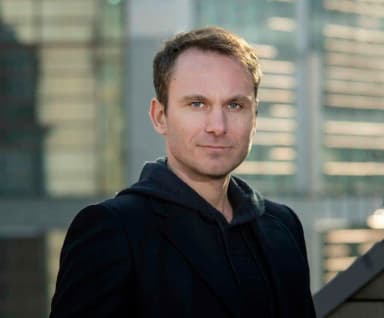
Paolo Ardoino
On this page
Paolo Ardoino: Quick Facts
- Birthplace
- Cisano sul Neva, Italy
- Nationality
- Italian
- Education
- University of Genoa (Computer Science)
- Known for
- Leading Tether and scaling USDt into the largest stablecoin
- Current role
- CEO of Tether, CTO of Bitfinex
Paolo Ardoino: The Architect Behind the World's Most Used Stablecoin
Paolo Ardoino is the Italian-born engineer who helped turn USDt into the most transacted dollar-denominated asset in crypto history, first as Chief Technology Officer and, since December 2023, as CEO of Tether. Best known for scaling the engines behind both Tether and Bitfinex, Ardoino blended pragmatic engineering with a strict operational mindset to keep a stablecoin running across peak volatility, multiple chains, and millions of daily settlements. His tenure coincided with the maturation of the stablecoin sector, the rise of multi-chain issuance, and a louder conversation about decentralization, transparency, and the future of open money.
Ardoino's influence is inseparable from the growth of USDt during the industry's boom and bust cycles. As Bitcoin matured from a cypherpunk experiment to a global liquidity layer, he positioned Tether as a connective tissue for payments, remittances, and crypto market plumbing. He speaks in systems and redundancy, but the impact has been social: more people with access to dollars, often in places where banking is weak and inflation is strong. His work sits at the crossroads of crypto exchanges, market infrastructure, and real economy use, making him a central, if sometimes controversial, crypto pioneer in the age of stablecoins.
In that story arc, the technical meets the political. Tether anchored dollar liquidity across Bitcoin and other networks, while Bitfinex became a proving ground for low-latency matching, custody hardening, and post-incident recovery. The result is one of the most consequential operational careers in crypto.
Early Life and Background
Born on 22 October 1984 in Cisano sul Neva, a small town in the Italian region of Liguria, Ardoino studied computer science at the University of Genoa, concentrating on distributed systems, networking, and resilient software. His earliest professional work involved cryptography and networking projects for military applications, and in 2013 he founded Fincluster, a startup building cloud-based financial software. That was the sort of backend engineering where performance, correctness, and uptime come first. That background proved decisive once he stepped into the unrelenting 24/7 environment of digital asset markets. The combination of finance-flavored systems and internet-scale thinking prepared him to lead teams that could support real-time order flow, risk controls, and messaging across geographies and time zones.
He built a reputation as a hands-on technologist and an operator who gravitated toward small, fast teams. Those instincts would shape his management style at both Bitfinex and Tether, where speed and reliability are table stakes and downtime is existential.
Entry into Crypto
Like many early adopters, Ardoino was pulled in by the elegance of permissionless networks and the practical potential of a bearer asset that settles globally. By the early to mid 2010s he was contributing to crypto trading infrastructure, drawn to the idea that open money could work at internet speed without traditional banking hours. He joined Bitfinex in 2014 as a senior software developer and became Chief Technology Officer in 2016, embracing the task of hardening one of the industry's most active trading venues.
Bitfinex's growth ran straight through a gauntlet of challenges. The 2016 security incident forced urgent engineering decisions and spurred a long-running focus on recovery, user restitution mechanisms, and layered defenses. Internally, Ardoino's mandate evolved from pure engineering to platform stewardship, where he bridged dev teams, operations, and risk management at a time when exchanges were learning to be both agile and conservative. This period also set the context for his later leadership at Tether, where scale, speed, and resilience would all converge.
Major Contributions and Projects
Ardoino's most visible contributions cut across two organizations that share DNA but solve different problems: Bitfinex for markets, Tether for money. The connective thread is reliability at scale.
At Bitfinex, he led the evolution of a low-latency matching engine, optimized API gateways, and internal services that could sustain heavy order flow. The exchange leaned into new rails and features early, including Lightning Network support and multi-collateral functionality, while continually iterating custody and operational security after 2016. In practical terms, the platform had to perform during flash crashes and liquidity spikes, which meant everything downstream of the matching engine had to be coordinated and measured. For readers new to exchange mechanics, see the primer on how venues route orders and manage custody in Understanding Crypto Exchanges.
His work at Tether began in earnest by 2017, first as an engineering leader and then as CTO, before stepping up to CEO in 2023. Over these years, USDt expanded from its original issuance on Omni to a multi-chain stablecoin, with heavy usage on Ethereum and Tron, and growing footprints on networks like Solana. This multi-rail strategy answered a simple market need: keep transfers cheap and fast, even during peak congestion. It also aligned with Ardoino's practical take on interoperability. Stablecoins are a use case where the network effect compounds quickly. When fees rise on one chain, traffic shifts to another. Designing issuance and treasury operations to work across chains became a core competency.
Tether also diversified its product set. Alongside USDt, the company issued EURt, CNHt, MXNt, and Tether Gold (XAUt). More importantly for market trust, the team overhauled reserve disclosures and attestation cadence, exited commercial paper holdings in 2022, and shifted toward short-dated U.S. Treasuries and cash equivalents. Operationally, that rebalancing reduced credit risk while aligning the asset side of the balance sheet with the daily redemption profile of a widely used stablecoin. For an overview of the role stablecoins play in crypto and beyond, see What Are Stablecoins?.
Ardoino's focus on plumbing has always been paired with a view of crypto's social utility. That is most visible in cross-border payments and inflation hedging, where stablecoins deliver dollar exposure without traditional bank accounts. In several emerging markets, merchants and exchanges increasingly use USDt as a settlement rail. While debates continue about regulation and oversight, the organic growth of stablecoin throughput is a durable fact of crypto infrastructure, interwoven with the liquidity backbone of Bitcoin and ERC-20 ecosystems.
Ardoino frequently places this work in a broader lineage of crypto builders, from protocol inventors like Satoshi Nakamoto to application-layer architects like Vitalik Buterin. Stablecoins are the connective tissue between these layers, turning base-layer innovation into daily economic activity. They are part of the larger migration toward architectures that move value as easily as information.
Philosophy and Vision
Ardoino's public philosophy is pragmatic and operator focused. He rarely speaks in abstract terms about decentralization without following quickly with engineering constraints and rollout details. The throughline is clear: build simple, resilient systems that survive peak load and adversarial environments. In his view, crypto's most valuable services must work on patchy networks, old phones, and during periods of regulatory uncertainty. This is why he emphasizes multiple chains and multiple custody options. The end goal is less about maximalism and more about uptime.
He also reads crypto through the lens of freedom to transact. That often leads him to prioritize Bitcoin, including Lightning integrations and tooling that attach to Bitcoin's liquidity gravity, while still keeping stablecoin issuance on chains that deliver low fees and high throughput.
Key Developments: From CTO to Tether CEO
Tether announced Ardoino's promotion in October 2023 and he formally took over from Jean-Louis van der Velde as CEO that December, a role that broadened his focus beyond engineering to strategy across finance, infrastructure, and data. Under his leadership, Tether outlined business lines that include financial services, education initiatives, and an energy strategy aimed at building and operating Bitcoin mining infrastructure in regions with underutilized power. The goal is twofold: support the resilience of the Bitcoin network and catalyze local energy development where it can have lasting economic impact.

The most visible strategic move of his tenure came in January 2025, when Tether relocated its headquarters from the British Virgin Islands to El Salvador after obtaining a digital asset service provider license there. Ardoino framed the decision around regulatory clarity, calling the country a natural base for a company whose growth comes overwhelmingly from emerging markets. The company had just reported roughly 13 billion dollars of net income for 2024, and it paired the move with plans to sharply expand local hiring.
The scale that followed is difficult to overstate. By the second quarter of 2026, USDt in circulation had climbed to roughly 184.6 billion dollars, more than 60 percent of the entire stablecoin market, spread across a user base that crossed 650 million wallets. Tether posted about 1.5 billion dollars in quarterly net operating profit, with reserves exceeding liabilities by roughly 4.1 billion dollars. Ardoino also pushed the treasury beyond Treasuries and Bitcoin into physical gold, lifting holdings past 146 metric tons and stating a target of allocating 10 to 15 percent of the non-Treasury portfolio to bullion.
In 2025 Tether also launched USAT, a separate United States-domiciled stablecoin issued through Anchorage Digital Bank and built for the new federal stablecoin framework. USDt is not officially offered to United States residents, so USAT gave Ardoino a compliant onshore product to compete directly with regulated rivals without disturbing the offshore token that generates the bulk of Tether's revenue.
Operationally, Tether also moved to formalize allocation policies around balance sheet management, including periodic Bitcoin purchases using a portion of net operating results. This approach positioned Tether not only as a stablecoin issuer but as a balance sheet actor that participates directly in the long-term health of the network it relies on. The policy sits alongside the company's ongoing reserve attestations and treasury diversification. For a wider lens on how crypto bridges into traditional finance instruments and on-chain assets, see Real World Asset Tokenization.
Ardoino's time as a senior Bitfinex executive also intersected with El Salvador's embrace of Bitcoin. Bitfinex Securities pursued licensing in the country, aligning with President Nayib Bukele's broader Bitcoin agenda. While still early, these moves hint at a future where exchanges and stablecoin issuers link public market issuance with digital rails at the national level. The next phase of stablecoins may be less about centralized dominance and more about interoperability with regulated issuance, securities tokenization, and governments exploring Central Bank Digital Currencies (CBDCs).
Controversies and Criticism
Ardoino's career runs through two of crypto's most scrutinized entities. Tether and Bitfinex have faced sustained criticism, regulatory actions, and media skepticism. In 2021, Tether and Bitfinex settled with the New York Attorney General without admitting wrongdoing, paying 18.5 million dollars and committing to enhanced reporting on reserves and operations. Later that year, the CFTC settled with Tether over historical disclosures about backing, resulting in civil penalties. Critics also argue that Tether has not delivered a full audit and that attestations, while regular and third party, fall short of maximal transparency.
Ardoino's response has typically stressed operational facts: daily redemptions, market functioning under stress, elimination of commercial paper, and a risk posture centered on short-duration assets. He argues that the strongest evidence is performance across cycles, including heavy redemptions in 2022 and subsequent net issuance in 2023 and 2024 as confidence recovered. Still, the debate persists. Some regulators and analysts prefer a bank-like supervisory model. Others contend stablecoins should be treated as a new category, with transparency standards tailored to their mechanics.
Finally, questions about market influence often surface, especially during periods of extreme volatility. Stablecoin minting, redemptions, and exchange liquidity interact with price discovery in complex ways. Understanding this dynamic benefits from a grounding in market microstructure and the human factor of sentiment, as captured in primers like Crypto Volatility.
Public Persona
Ardoino's public presence is that of a builder-operator who blends bluntness with steady messaging. On social media he communicates in terse updates, incident responses, and engineering teasers, often aimed at dispelling rumors in real time. The tone is typical of an infrastructure lead who must balance transparency with operational security. In conferences and interviews he favors demonstrations over hype, pointing to throughput, redemption mechanics, and new integrations rather than visionary slogans. That said, he regularly situates Tether within the bigger arc of open networks, often referencing the foundational work of Satoshi Nakamoto and the application layers pioneered by teams around Ethereum.
This dual identity as both exchange technologist and stablecoin steward also places him in dialogue with other industry leaders. The interplay with exchange founders like Changpeng Zhao offers a running case study in how liquidity, corporate treasury choices, and infrastructure strategy shape adoption. On the exchange front, Bitfinex remains one of crypto's older venues, distinct from retail-heavy platforms like Coinbase or power users gravitating toward Binance. For a direct look at the venue Ardoino helped scale, see Bitfinex.
Legacy and Influence
Paolo Ardoino's legacy is tightly bound to the normalization of stablecoins as everyday crypto money. When historians recount how crypto crossed from speculation into settlement, they will point to the operational reliability of USDt across peak load, cross-chain migrations, and periods of severe market stress. They will also note the institutionalization of reserve management and a relentless focus on making stable transfers cheaper, faster, and globally available. In parallel, his role at Bitfinex preserved an early exchange's place in a competitive field by turning hard lessons into resilient engineering.
He belongs to a generation of crypto builders who absorbed the ideals of decentralization while translating them into working systems. As networks evolve, scaling improves, and programmable money matures, Ardoino's influence will be measured in throughput rather than headlines, and in the number of people who use crypto not for novelty but because it quietly works. The arc of his career suggests that crypto's future belongs to the operators who keep the lights on and the packets moving.
Paolo Ardoino: Frequently Asked Questions
Who is Paolo Ardoino?
Paolo Ardoino is an Italian software engineer who has served as CEO of Tether since December 2023 and as Chief Technology Officer of the Bitfinex exchange since 2016. He joined Bitfinex as a developer in 2014 and led Tether's engineering as CTO from 2017 before taking the top job.
What is Tether and how big is USDt?
Tether issues USDt, the largest dollar-pegged stablecoin in crypto. By mid-2026 roughly 184 billion USDt were in circulation across more than 650 million user wallets, giving it well over half of the entire stablecoin market.
Why did Tether move its headquarters to El Salvador?
Tether relocated from the British Virgin Islands to El Salvador in January 2025 after securing a digital asset service provider license there. Ardoino pointed to the country's regulatory clarity and its Bitcoin-friendly framework as the main reasons for the move.

